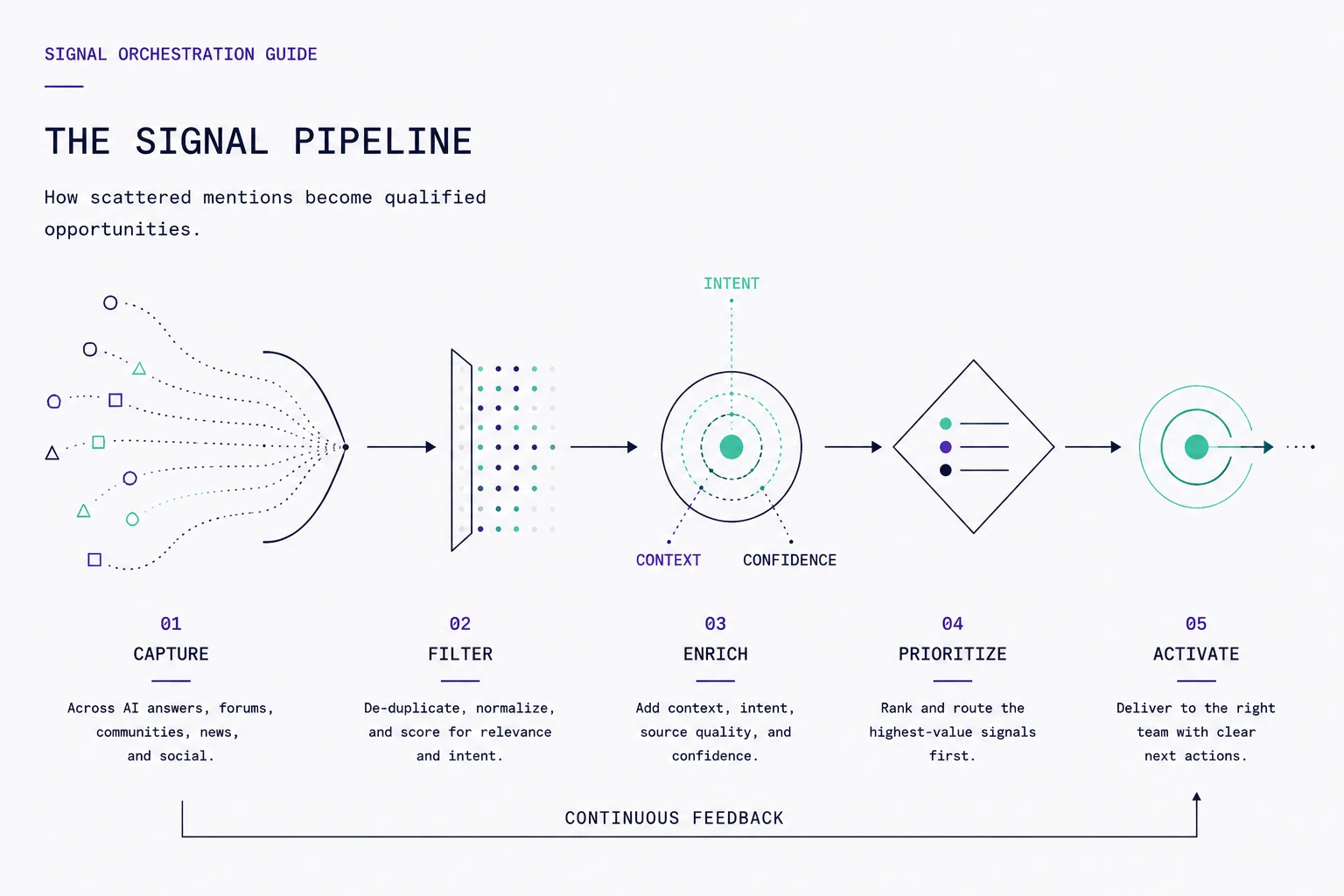
From signal accumulation to decision architecture
Intent feeds, call transcripts, product usage, CRM stages, public research, and technical context each reveal part of an account. None independently proves what the buying group believes or what a rep should do next.
A signal becomes actionable only when its source, freshness, uncertainty, buyer relevance, and permitted use are visible to the person responsible for the next move.
The five-layer orchestration model
Observe
Capture approved signals with source, date, account, stakeholder, and privacy context intact.
Resolve
Connect the signal to the correct account, buying-group role, product, category, and opportunity without hiding uncertainty.
Interpret
Translate the signal into a buyer question or commercial hypothesis. Keep inference separate from evidence.
Assign
Name the owner, response window, approved action, dependency, and stop condition.
Learn
Record completion and acceptance evidence so the team can review usefulness without claiming causation.
Four triggers where orchestration matters
Language shifts
Connect search, conversation, and competitive signals to the category questions leadership must answer.
Compatibility and adoption
Connect product, usage, and buyer evidence to fit, implementation, security, and expansion questions.
Stagnation and missing stakeholders
Connect deal movement and conversation gaps to the buying-group roles and proof conditions still unresolved.
Displacement windows
Connect named alternatives and timing signals to supported comparison guidance for active opportunities.
What belongs in a governed action record
| Field | Question it answers | Control |
|---|---|---|
| Source and condition | Where did this signal come from, and under what conditions? | Preserve provenance and freshness. |
| Buyer relevance | Which stakeholder question or decision stage does it affect? | Do not infer intent from activity alone. |
| Owner and action | Who may act, and what are they authorized to do? | Bound scope, channel, timing, and approval. |
| Acceptance evidence | How will the team know the action was completed usefully? | Measure completion separately from revenue causation. |
Agents accelerate the loop. They do not own the mandate.
Automated enrichment, synthesis, content drafting, task creation, or CRM execution requires explicit permissions, inspectable inputs, named human ownership, and a stop path. Silence is not approval, and a model score is not commercial truth.